
The bazaar is a special place on the map of any city. The authorities never liked it, but were forced to tolerate its existence — because the bazaar was a means of survival for the population, especially in hard times. It was a place where you could buy everything that was absent from store shelves during the era of total shortages. You could sell there too. And barter. In short, the bazaar was always a gathering point for city dwellers of all classes and income levels. Today, bazaars have become markets — no longer a free congregation of people trading freely, but a place of organized commerce with regulated prices and a fixed range of goods. “The fly went to the bazaar and bought a samovar” is a thing of the distant past, though if you wander around the edges of a market, you can still stumble upon peddlers offering the most unexpected wares. But that now falls under the category of illegal trade.

Spontaneous street trading — from the ground, from a bucket, from a battered crate. Unsanctioned, but effective. Brest, 2014.

The meat stalls. Central Market. Brest, 2014.
In Brest, the bazaar was always a popular place to shop — even after it shifted location somewhat, acquired a roof, and changed its name, first to the Kolkhoz Market, and then simply to the Central Market. Though it had always been central. Under Poland, under the Soviets, during the occupation, and after liberation — the market remained in the heart of the city, only shifting its precise location slightly by the 1960s. I went to the Brest bazaar for the first time when I was a schoolgirl. We used to run there to buy sunflower seeds — semachki or semki, as they were called. And if we were lucky, we’d snag a rooster lollipop on a stick from the Romani women. The roosters were red and yellow, with no wrappers. Where and under what conditions they were cast and colored didn’t concern us in the slightest. The seeds lay in mounds. You had to go around all the vendors, taste from each, and only then buy. They were sold by the small or large faceted glass — heaped high. Gradually, the faceted glasses gave way to smooth, tapered ones, considerably reducing the volume — while the price rose from 10 kopecks to 30. In our family, only my grandfather went to the bazaar regularly. One of my worst childhood memories was his habit of buying live chickens or roosters there. I never saw him cut off their heads, or my grandmother pluck the slaughtered birds — but the dread and the thought “the poor birdie” still wash over me to this day. After the market moved indoors, I went there just twice, so I’m not in any position to assess the quality of produce, prices, or service. The one thing I know for certain is that such establishments, in the form they are organized and operate, are a purely Soviet invention — one that has survived and remains in demand only in post-Soviet territories.

Not the main entrance to the Central Market. Brest, 2014.
During the occupation and after liberation, the bazaar was located on the square where the bus station was built in 1963. City residents who remembered pre-war Brest called the market the Maly Bazar — the Small Bazaar. After the new bus terminal opened in May 2019, the square was once again freed up for the city authorities’ imagination to wander. How, who, and what was traded at the bazaar w czasach polskich (in Polish times) and during the occupation is a separate story. Photographs from the occupation years appear periodically at various auctions or among collectors, and some of them captured the Brest Bazaar.

The everyday life of occupation. A Polish resistance fighter hanged by the occupiers on the balcony of a building near the Small Bazaar, across from a fish shop. Some of the buildings burned during the bombing raids of July 1944; others were demolished during the construction of the bus terminal. (Drawing by V. Gubenko)

The Small Bazaar. Brest, summer 1941. (Photo from the archive of N. Levine)

The Small Bazaar. Brest, winter 1942. (Photo from the archive of N. Levine)

The Small Bazaar. Brest, winter 1942. (Photo from the archive of N. Levine)
A sketch of daily bazaar life in 1944–1945 was captured in words and pencil by V. Gubenko. The market was right next to School No. 5, where he studied. Slipping off to the bazaar during a break between lessons was a perfectly ordinary thing to do. Some boys — especially those who had been through the school of survival during the German occupation — even managed to conduct a bit of gesheft (a little business deal) while they were at it. “I visited the bazaar every day — walking to school, during breaks, on my way home. It was impossible to pass by, since it was just a short distance from my School No. 5, where I studied until 1947. From early morning until evening the place was packed with people. The bazaar stretched across the area from Kuibyshev Street to Karbysev Street, along Mickiewicz Street. That is now the bus terminal square. The only surviving remnant of those years is the fish shop, and the bakery on the corner of Mickiewicz and Karbysev Streets — rebuilt beyond recognition. The water tower was built in the 1950s on the site of a large wooden tower with a water pump. Water was sold by an attendant. The customers never stopped coming.”
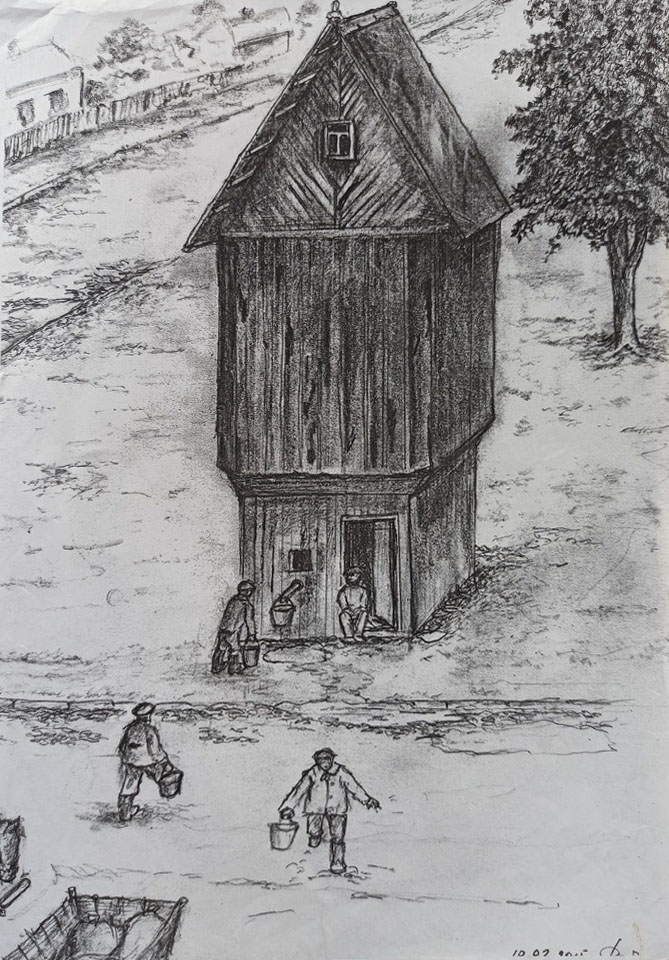
1945. The wooden water tower with a pump column, where water was sold for money to anyone who wanted it. It was demolished and replaced in the 1950s with a concrete tower that still stands today on the square of the former bus terminal. (Drawing by V. Gubenko)

The former bazaar square, the former bus terminal square, with the water tower. No, it’s not Pisa. Brest, 2018.
In the far end of the market, behind the fish shop, stood unhitched peasant carts. On them were laid out potatoes, beets, carrots, cabbage, apples, and neat bundles of firewood. Across the square stood several rows of wooden tables, where foods I had long forgotten during the hungry evacuation were on sale: milk, sour cream, butter, cottage cheese, a dry, rock-hard but very tasty pressed curd cheese, chickens and ducks — slaughtered and live — pork, mutton, salted lard sprinkled with caraway seeds, flour, eggs, honey — linden and flower honey, liquid and solid, in the comb. People sold hot pyzy (dumplings), cotton candy, and hrushanky-gnilki (a local pear variety). On spread-out oilcloths they traded all manner of hardware for the home, tools, and German illustrated magazines.

Panorama of the school courtyard and the city market. Kuibyshev Street, autumn 1944. (Drawing by V. Gubenko)
Nearly a third of the bazaar was occupied by the flea market — the tolkuchka. In the 1950s it was relocated to the wasteland left by a city block that had burned in 1944. The area was enclosed by a tall fence. The tolkuchka served city residents as the dry-goods department of the bazaar’s supermarket. Before the relocation, buyers and sellers of all manner of things crowded the intersection of Mickiewicz and Kuibyshev Streets, often blocking it entirely. You could arrive at the tolkuchka with nothing but the shirt on your back and leave dressed head to toe — in new or second-hand clothes, depending entirely on the thickness of the wad of bills in the buyer’s hand. The shelves of the city’s one department store and the handful of dry-goods shops could not compete with the tolkuchka, either in price or in variety. The whole thing kept shifting and churning like a living illustration of Brownian motion, overflowing so that it spilled into adjacent streets and courtyards. Gambling flourished: three-card games, shell games with thimbles on a piece of plywood laid on the ground — luring people in with easy winnings. There was even a portable roulette wheel in a fiber suitcase, and many other games designed to tempt those looking for easy money. A sort of miniature Las Vegas. There were primitive ring-toss games with enticing prizes. Many people played. Nobody won. Pickpockets, swindlers, and thieves circulated through the crowd. Police patrols paid no attention to the gamblers. Their main task was catching moonshine sellers. That trade was booming, but catching the bootleggers was extremely difficult — you could only catch them in the act of selling, and such transactions took place beyond the bazaar’s perimeter. Confiscating the goods was sometimes accompanied by gunfire, as the sellers — mostly village women — had no desire to part with their merchandise. The crackdown on moonshine traders was prompted by a sharp increase in the number of drunk soldiers on the city streets, and the resulting rise in hooliganism and brawling — sometimes very brutal — between servicemen of different branches, especially with the sailors who had appeared in Brest seemingly from nowhere, and who held the army in great contempt.

This is how the Small Bazaar looked in the early 1950s. The trading rows were still standing — almost always shuttered — framing the corner of Kuibyshev Street and School Lane. The city’s flea market (tolkuchka) had been moved to the wasteland left by the burned-out city block. (Drawing by V. Gubenko)
A certain threat to the bazaar world came, strange as it may seem, from the wounded soldiers at the military hospital located right next to the market. The hospital was housed in the former Russian gymnasium named after Traugutt. We visited the hospital wards several times with school concert performances. There were many seriously wounded men — many with amputated limbs. Convalescing soldiers crowded the pavements in front of the hospital on fine days, or sat on the brick fence. I witnessed, on one occasion, a large crowd of wounded men — brandishing crutches and walking sticks — fall upon the market stalls, scattering sellers and buyers, smashing everything left and right. People fled in panic. Whatever was left behind became the patients’ spoils — mostly food: butter, lard, eggs, milk, and the like. The military patrols and the police fled along with everyone else. No one dared enter into open conflict with the rampaging invalids. After the raid, the soldiers — loaded down with provisions — returned to the hospital. Some sat down beneath the fence to divide the spoils and rest in the shade of the chestnut trees, while the market gradually calmed and filled again with buyers and sellers. Before the hospital was relocated, there were several such raids.
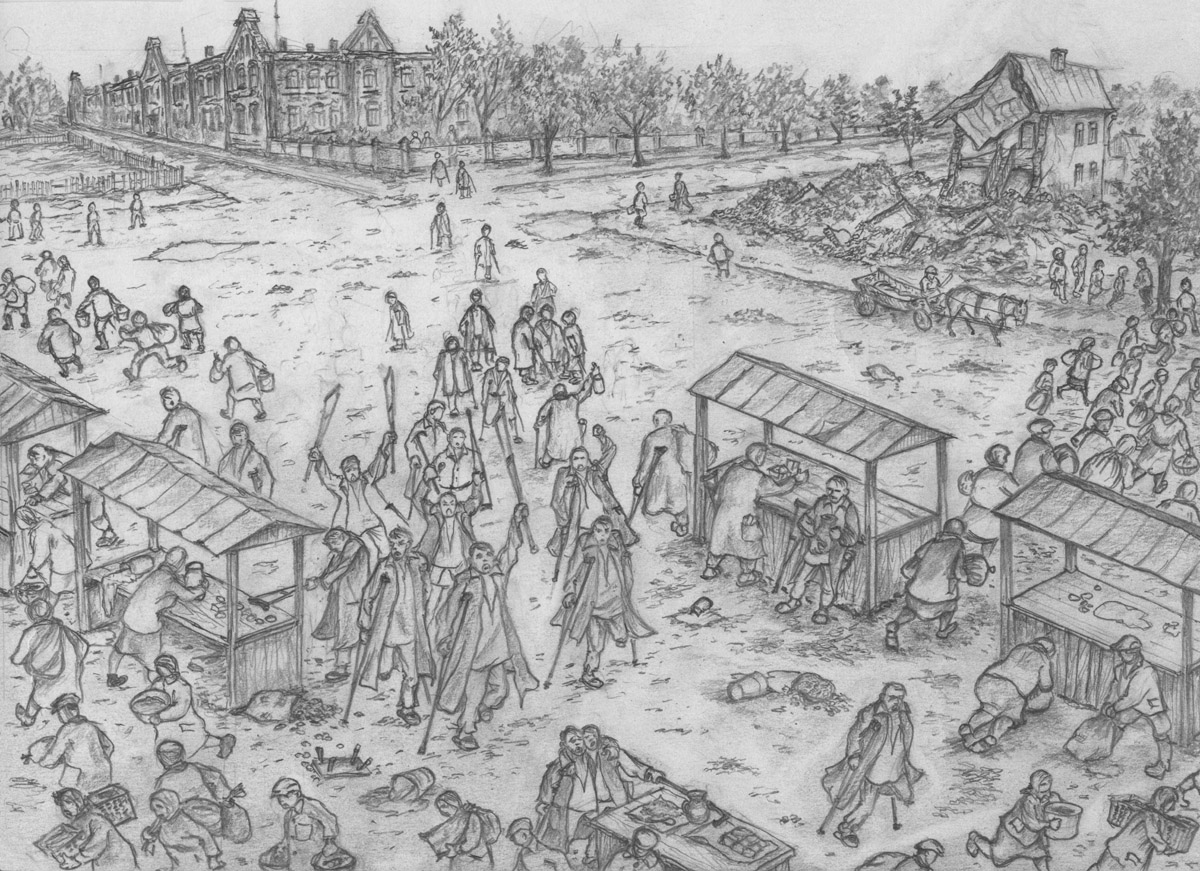
A raid on the market by wounded soldiers undergoing treatment at the nearby military hospital. (Drawing by V. Gubenko)
In short, the bazaar was a noisy, fascinating, utterly remarkable and unfamiliar world of commerce, which I observed every day. But that was not the main thing. What struck me was the abundance of produce at the market. After the hungry years of evacuation, it seemed like a fantasy. In the newspapers I had read that the occupiers had plundered the population, that people were not merely suffering but dying of famine, that all provisions had been sent to Germany. I kept asking myself: where did all this abundance come from? The local boys were well-fed and well-dressed, and from our gaunt appearance and worn-out clothes they immediately identified us as Easterners. The peasants at the market who brought their produce were neither ragged nor thin. Their horses, with quality leather harnesses, looked healthy and strong; the carts were solid and reliable. And yet for three years they had been obliged to hand over a portion of their harvest to the occupiers as compulsory military quotas. Their bread and butter had also fed the partisans and the police — all the armed men of every stripe, who simply confiscated food, livestock, and horses from the peasants without payment. And often took their lives along with it. So what explained it? There are probably many factors. But the main one is that peasant farming was still individual. After the annexation of Western Belarus to the USSR, Soviet authorities had partially begun collectivization — but the process was interrupted by the war. In the first post-war years, Soviet power did not yet feel strong enough to forcibly drive peasants into collective farms. But by 1949, the hand of the state had grown firm enough that within two years, the mass forced collectivization of peasant households across Western Belarus was carried out. But that was still nearly five years away — which is why abundance reigned at the Brest market, while the post-war policy of forced grain requisitions applied to the already-existing collective and state farms condemned the rural population of eastern regions to mass famine in 1946–1947.” (From the memoirs of V. Gubenko)

The ruins after the July 1944 bombing raids. The Brest Central Market now stands on this site, running from Kuibyshev Street with its façade facing Pushkin Street. (Drawing by V. Gubenko)
Rebuilt many times over, the Brest bazaar eventually took on the form that newer generations of Brest residents have grown accustomed to. Some still call it the kolkhozka — though the word “kolkhoz” disappeared from the sign above the entrance long ago, just as the collective farmers themselves disappeared from behind the counters. It is now the domain of farmers, cooperatives, wholesalers, hired vendors — and, of course, seasonal mushroom and berry pickers. The bazaar has definitively become a market. Everything is orderly and regulated, prices clearly displayed. Coming across someone selling tomatoes they’ve grown themselves, or cucumbers — crisp and sweet, covered in tiny bumps, picked just that morning with the leaves still on and the little yellow flowers not yet wilted — has become a true rarity. Most of the stalls, with their identical assortment of vegetables and fruit, are staffed by city-looking women somewhere between 20 and 60, selling goods that are delivered centrally and distributed among the vendors. Buy and go. But islands of the real bazaar survive. Many people go exclusively to “their” vendors, with whom they’ve built years of trust and mutual benefit. Fresh cottage cheese from tidy Valentina; veal — reliably good — from dependable Gena; the sausage with saltison only from Raisa; Baba Vera says don’t take the apricots from her today — they’re sour, she’ll have sweet ones in two days. And then there are the chance encounters — inevitable at every visit, regardless of the day of the week or time of year — with acquaintances: you might exchange a few words, or you might get drawn in for an hour, or you might walk past pretending not to notice — but the fact of the encounter remains, one way or the other. So there’s no getting away from the bazaar. The bazaar is eternal and indispensable. You just have to know how to filter it.

A residential building across from the former bus terminal. Brest, 2018.