Once upon a time…

Once upon a time, “early on a grey winter morning, three rusty single-decker buses pulled out of Warsaw. Like relics of the Soviet era, they trailed black smoke and foul diesel fumes as they headed east. In the first bus rode an Honorary Judge of the High Court of England, two Queen’s Counsel and their junior barrister, along with court stenographers and several officials from London’s Central Criminal Court — better known as the Old Bailey. The second bus carried the jury — eight men and four women — along with six court officials and two officers from the Metropolitan Police’s Jury Protection Unit, to ensure there was no contact between the jurors and the British press, who occupied the third bus. They were travelling not just to a country none of them knew; they were journeying into the past, to stand at the scene of crimes committed 57 years before. The accused, who had been living in Britain for more than 50 years, unrecognised and unsuspected, remained in London. His trial had been adjourned for the unprecedented visit of a British jury abroad.” (The Ticket Collector from Belarus, p. 1)

The Old Bailey (Central Criminal Court). It hears criminal cases of a serious or sensitive nature that attract wide public interest. London.

Once upon a time. That is how English fairy tales usually begin. The events that took place in Brest in February 1999 were no fairy tale — but for many, they seemed like something out of fiction. Not least for the British citizens themselves. Their arrival in Belarus was connected to the trial of Andrei Sawoniuk. Sawoniuk was the first — and only — person to be convicted on British soil under the War Crimes Act. This unprecedented case attracted extensive coverage in both the foreign and domestic press. In 2022, Mike Anderson and Neil Hanson published a book titled The Ticket Collector from Belarus. Following the international success of the first edition, a second print run was released in London in January 2023. Who Sawoniuk was, what crimes he committed, and how he was identified half a century after the war’s end can be read on the excellent website domachevo.com and at rubon-belarus.com. From a legal standpoint, the Sawoniuk case was also unique because, for the first time in the history of British justice, a jury travelled abroad to view the scene of the crime. Sawoniuk was defended by one of the finest Queen’s Counsel of the day, William Clegg. He was confident he had chosen the right and reliable line of defence — arguing that the jury could not deliver a fair verdict, as they had not seen the scene of the crime, and that getting to Domachevo, at the ends of the earth, would never be granted even if he petitioned for it, since no British jury had ever gone abroad. However, the War Crimes Act, passed back in 1991 — which had made it possible to bring charges for crimes committed by foreigners against foreigners on foreign soil — gave the presiding judge, Sir Humphrey Potts, the authority to make a unilateral decision to send the jury to Belarus. William Clegg had not anticipated this turn of events at all. In essence, it was his own words that prompted the judge to order the organisation of this enormously complex visit. Beyond the bureaucratic hurdles required to observe every degree of legal propriety, certain measures had to be taken within the delegation itself. To ensure an impartial trial, not a single member of the jury was Jewish; and at the request of both the defence and the prosecution, all jurors were required to confirm that none of their relatives had been victims of the Holocaust.

At the preliminary hearing on 21 December 1998, Judge Potts granted the defence counsel’s application for the jury to visit Domachevo, in what is now Belarus. The defendant does not attend. The planned itinerary for the jury’s visit. (Photo from the book “The Ticket Collector from Belarus”)

The numerous representatives of the British press were strictly forbidden not only from speaking to the jurors, but from coming within 40 paces of them. To enforce this rule, the jurors were accompanied everywhere by court officers dressed in conspicuously bright yellow vests. Until the final verdict was delivered, British journalists were prohibited from publishing or distributing any information relating to the investigation. The journey was gruelling — both morally and physically — from the very moment they reached the border: “The snow-covered landscape through which they were travelling was flat and marshy, broken only by birch forests and small, impoverished villages. The hundred-mile journey took four hours, and was frequently slowed to a crawl by sudden snowdrifts whipped up by a biting east wind. As they approached the Belarusian border, where surly guards routinely held up travellers for hours or even days, they saw a queue stretching back for several kilometres. An enterprising vendor had set up a roadside stall selling hot soup to drivers waiting in line. Several equally enterprising prostitutes, wearing miniskirts and low-cut tops despite the bitter cold, could be seen climbing into the cabs of some of the lorries. Everyone understood that they were bribing the border guards to delay the document checks for as long as possible, giving the prostitutes time to service the bored drivers. Thanks to the local chief of police, acting as ‘facilitator’, the convoy swept past the queue and pulled straight to the front. The police chief distributed packets of Western cigarettes to the guards and customs officers. Documents had to be checked and stamped at every stage of the process. By the time the buses cleared the final hurdle, a dozen stamps had been added to the forms. After a delay of just 65 minutes, the convoy crossed the border. Despite this, one reporter still remarked cynically that it had taken them longer to cross the border than it had taken the German army in 1941.” (The Ticket Collector from Belarus, p. 2) And then came the accommodation — at the Intourist, the finest hotel in Brest. “The night before, the British delegation had stayed in a relatively luxurious four-star hotel in Warsaw, but on their first night in Belarus they had to make do with the considerably less comfortable Hotel Intourist in Brest-Litovsk. As The Times described it: ‘a hostel radiating all the charm of a tax office.’ Rumours had circulated that emergency renovations had been carried out before the English arrived, but no evidence of this was visible in the spartan, cold interior. Some rooms had broken windows; none of the washbasins had plugs*, and when guests ran out of toilet paper, they were required to bring the empty cardboard tube to the front desk before a new roll would be issued. (* The English are accustomed to washing by filling the basin and stopping the drain with a plug — a translator’s note.)

Hotel Intourist, Brest, 1990s. (Photo from the archive of I. Chaichits)

Scotland Yard’s War Crimes Unit detectives had already made several trips to Belarus to interview potential witnesses and had learned to bring their own food, portable heaters, and even tape to seal the gaps in the windows — but the jurors and court officials had not been warned of any of this, and had no choice but to endure the cold and other hardships. As in Soviet times, each floor of the hotel was presided over by an elderly woman seated on a chair opposite the clanking lift, monitoring the comings and goings of guests. The telephones in the rooms emitted strange clicks and crackles, suggesting they were bugged. Prostitutes patrolled the hotel corridors, knocked on bedroom doors, and solicited guests in the bar — which, it should be said, the British press had rapidly drunk dry. The hotel restaurant menu promised an impressive array of dishes, but every attempt to order anything was met with the waiter’s cry of “Nyet!” “Nyet!” “Nyet!” It turned out there was nothing available except boiled chicken.

The lobby of Hotel Intourist, 1990s. Brest. (Photo from the archive of Ivan Chaichits)

One of the Englishmen resigned himself to the inevitable and ordered the boiled chicken.
“I’ll have the same,” said his companion.
“Nyet!” — the waiter pointed to the man who had ordered first — “That is already his chicken.”
Fortunately, a curry house happened to be nearby (the India restaurant — translator’s note). When its owner was asked how he had ended up in such an unlikely place, he explained that he had bought the establishment sight unseen before leaving India, in the firm belief that he was acquiring a restaurant in a city called Brest located in France. He only discovered his mistake when the sale documents arrived in the post. Unable to get his money back, he had no choice but to come to Brest-Litovsk, and had been running one of Belarus’s very few Indian restaurants ever since. The food was good, and the prices so low that, to the considerable dismay of the British journalists, it was impossible to spend more than two or three pounds on dinner. When the bills arrived, the group’s senior official declared: “No, no, no! This simply won’t do.” He then asked the restaurant owner for a receipt book and wrote himself and his colleagues considerably more acceptable bills for expense-claim purposes.” (The Ticket Collector from Belarus, pp. 2–3)

The India restaurant, 1990s. (Now “Jules Verne.”) Photo from the archive of N. Alexandrov.

The British party returned to the India restaurant after coming back from Domachevo as well. This time their visit to the curry house was an act of gratitude to the local chief of police for his assistance in “clearing the obstacles.” The representatives of British justice ordered a couple of bottles of wine, which plunged their guest into deep gloom. Only when barrister Clegg asked whether the guest might prefer vodka did the police chief’s face light up with happiness. He drank the entire bottle with great relish — and then got behind the wheel of his car and drove the British contingent back to the hotel. But that came later. For now, they had a night at the Intourist ahead of them, before setting off the next day for the scene of Andrei Sawoniuk’s crimes — while Sawoniuk himself awaited the verdict under house arrest in his London flat. “Next morning at ten o’clock, after a near-inedible complimentary breakfast — the coffee had to be ordered separately at additional cost — the convoy set off again to cover the last rough and potholed stretch of the route. A police escort of rusty dark-blue Ladas led the way with flashing lights and wailing sirens, while the remaining traffic was halted by a large number of policemen who saluted the passing convoy.” (The Ticket Collector from Belarus, p. 4) The trip to Domachevo clearly made a powerful impression on the jury and had its effect. Judge Humphrey Potts, leading the delegation, did everything in his power to walk through the very places where Andrei Sawoniuk had left his bloody mark 57 years before. After all they had seen and heard, not a shadow of doubt remained in anyone’s mind about the guilt of “the butcher of Domachevo.” The British party stayed in Domachevo until nearly evening, then returned to Brest.

Sir Humphrey Potts (1931–2012). The presiding judge at the Sawoniuk trial.

The following morning, before departing for Warsaw, the jurors asked to be allowed to visit the GUM department store. It turned out to be a dim and poorly maintained space, though they did manage to find some charming and original souvenirs. In the electrical goods section, the jurors encountered — as they described it — “an antique toaster” standing in solitary splendour, and an equally solitary sales assistant who was watching a football match on a small television screen and making every effort not to catch the eye of any potential customer.

GUM department store, Brest, 1980s. The British, being devoted tea-drinkers, were not fortunate enough, by the 1990s, to find such an abundance of teapots on the shelves of Brest’s main shopping emporium.

Then the British got back on their buses and headed home.
The trial took place in March 1999. Throughout the proceedings, Sawoniuk — in his distinctive mixture of Cockney and Polish — insisted that he had never shot anyone and was innocent of all charges. The witness testimonies, the documents uncovered, and the visit to Domachevo made it possible for the British jury to deliver the only possible verdict: guilty. Sawoniuk was sentenced to two life terms. In 2000 he sought leave to appeal, but the House of Lords issued a categorical ruling: denied. Sawoniuk died of natural causes in Norwich Prison at the age of 84. Once upon a time…..

A Little Filter for the Brest Bazaar

The bazaar is a special place on the map of any city. The authorities never liked it, but were forced to tolerate its existence — because the bazaar was a means of survival for the population, especially in hard times. It was a place where you could buy everything that was absent from store shelves during the era of total shortages. You could sell there too. And barter. In short, the bazaar was always a gathering point for city dwellers of all classes and income levels. Today, bazaars have become markets — no longer a free congregation of people trading freely, but a place of organized commerce with regulated prices and a fixed range of goods. “The fly went to the bazaar and bought a samovar” is a thing of the distant past, though if you wander around the edges of a market, you can still stumble upon peddlers offering the most unexpected wares. But that now falls under the category of illegal trade.

Spontaneous street trading — from the ground, from a bucket, from a battered crate. Unsanctioned, but effective. Brest, 2014.

The meat stalls. Central Market. Brest, 2014.

In Brest, the bazaar was always a popular place to shop — even after it shifted location somewhat, acquired a roof, and changed its name, first to the Kolkhoz Market, and then simply to the Central Market. Though it had always been central. Under Poland, under the Soviets, during the occupation, and after liberation — the market remained in the heart of the city, only shifting its precise location slightly by the 1960s. I went to the Brest bazaar for the first time when I was a schoolgirl. We used to run there to buy sunflower seeds — semachki or semki, as they were called. And if we were lucky, we’d snag a rooster lollipop on a stick from the Romani women. The roosters were red and yellow, with no wrappers. Where and under what conditions they were cast and colored didn’t concern us in the slightest. The seeds lay in mounds. You had to go around all the vendors, taste from each, and only then buy. They were sold by the small or large faceted glass — heaped high. Gradually, the faceted glasses gave way to smooth, tapered ones, considerably reducing the volume — while the price rose from 10 kopecks to 30. In our family, only my grandfather went to the bazaar regularly. One of my worst childhood memories was his habit of buying live chickens or roosters there. I never saw him cut off their heads, or my grandmother pluck the slaughtered birds — but the dread and the thought “the poor birdie” still wash over me to this day. After the market moved indoors, I went there just twice, so I’m not in any position to assess the quality of produce, prices, or service. The one thing I know for certain is that such establishments, in the form they are organized and operate, are a purely Soviet invention — one that has survived and remains in demand only in post-Soviet territories.

Not the main entrance to the Central Market. Brest, 2014.

During the occupation and after liberation, the bazaar was located on the square where the bus station was built in 1963. City residents who remembered pre-war Brest called the market the Maly Bazar — the Small Bazaar. After the new bus terminal opened in May 2019, the square was once again freed up for the city authorities’ imagination to wander. How, who, and what was traded at the bazaar w czasach polskich (in Polish times) and during the occupation is a separate story. Photographs from the occupation years appear periodically at various auctions or among collectors, and some of them captured the Brest Bazaar.

The everyday life of occupation. A Polish resistance fighter hanged by the occupiers on the balcony of a building near the Small Bazaar, across from a fish shop. Some of the buildings burned during the bombing raids of July 1944; others were demolished during the construction of the bus terminal. (Drawing by V. Gubenko)

The Small Bazaar. Brest, summer 1941. (Photo from the archive of N. Levine)

The Small Bazaar. Brest, winter 1942. (Photo from the archive of N. Levine)

The Small Bazaar. Brest, winter 1942. (Photo from the archive of N. Levine)

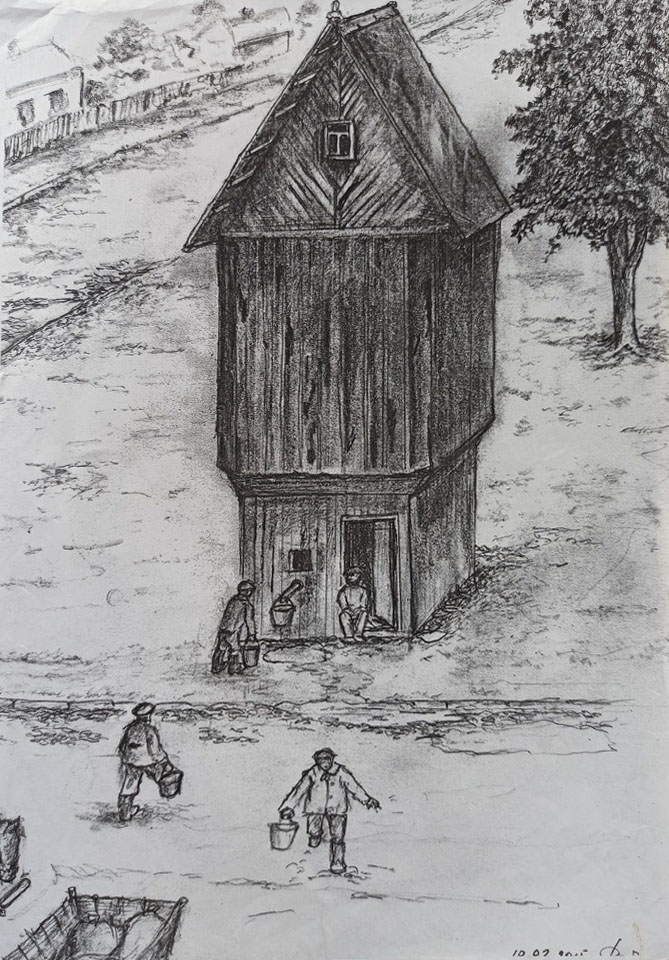
A sketch of daily bazaar life in 1944–1945 was captured in words and pencil by V. Gubenko. The market was right next to School No. 5, where he studied. Slipping off to the bazaar during a break between lessons was a perfectly ordinary thing to do. Some boys — especially those who had been through the school of survival during the German occupation — even managed to conduct a bit of gesheft (a little business deal) while they were at it. “I visited the bazaar every day — walking to school, during breaks, on my way home. It was impossible to pass by, since it was just a short distance from my School No. 5, where I studied until 1947. From early morning until evening the place was packed with people. The bazaar stretched across the area from Kuibyshev Street to Karbysev Street, along Mickiewicz Street. That is now the bus terminal square. The only surviving remnant of those years is the fish shop, and the bakery on the corner of Mickiewicz and Karbysev Streets — rebuilt beyond recognition. The water tower was built in the 1950s on the site of a large wooden tower with a water pump. Water was sold by an attendant. The customers never stopped coming.”

1945. The wooden water tower with a pump column, where water was sold for money to anyone who wanted it. It was demolished and replaced in the 1950s with a concrete tower that still stands today on the square of the former bus terminal. (Drawing by V. Gubenko)

The former bazaar square, the former bus terminal square, with the water tower. No, it’s not Pisa. Brest, 2018.

In the far end of the market, behind the fish shop, stood unhitched peasant carts. On them were laid out potatoes, beets, carrots, cabbage, apples, and neat bundles of firewood. Across the square stood several rows of wooden tables, where foods I had long forgotten during the hungry evacuation were on sale: milk, sour cream, butter, cottage cheese, a dry, rock-hard but very tasty pressed curd cheese, chickens and ducks — slaughtered and live — pork, mutton, salted lard sprinkled with caraway seeds, flour, eggs, honey — linden and flower honey, liquid and solid, in the comb. People sold hot pyzy (dumplings), cotton candy, and hrushanky-gnilki (a local pear variety). On spread-out oilcloths they traded all manner of hardware for the home, tools, and German illustrated magazines.

Panorama of the school courtyard and the city market. Kuibyshev Street, autumn 1944. (Drawing by V. Gubenko)

   Nearly a third of the bazaar was occupied by the flea market — the tolkuchka. In the 1950s it was relocated to the wasteland left by a city block that had burned in 1944. The area was enclosed by a tall fence. The tolkuchka served city residents as the dry-goods department of the bazaar’s supermarket. Before the relocation, buyers and sellers of all manner of things crowded the intersection of Mickiewicz and Kuibyshev Streets, often blocking it entirely. You could arrive at the tolkuchka with nothing but the shirt on your back and leave dressed head to toe — in new or second-hand clothes, depending entirely on the thickness of the wad of bills in the buyer’s hand. The shelves of the city’s one department store and the handful of dry-goods shops could not compete with the tolkuchka, either in price or in variety. The whole thing kept shifting and churning like a living illustration of Brownian motion, overflowing so that it spilled into adjacent streets and courtyards. Gambling flourished: three-card games, shell games with thimbles on a piece of plywood laid on the ground — luring people in with easy winnings. There was even a portable roulette wheel in a fiber suitcase, and many other games designed to tempt those looking for easy money. A sort of miniature Las Vegas. There were primitive ring-toss games with enticing prizes. Many people played. Nobody won. Pickpockets, swindlers, and thieves circulated through the crowd. Police patrols paid no attention to the gamblers. Their main task was catching moonshine sellers. That trade was booming, but catching the bootleggers was extremely difficult — you could only catch them in the act of selling, and such transactions took place beyond the bazaar’s perimeter. Confiscating the goods was sometimes accompanied by gunfire, as the sellers — mostly village women — had no desire to part with their merchandise. The crackdown on moonshine traders was prompted by a sharp increase in the number of drunk soldiers on the city streets, and the resulting rise in hooliganism and brawling — sometimes very brutal — between servicemen of different branches, especially with the sailors who had appeared in Brest seemingly from nowhere, and who held the army in great contempt.

This is how the Small Bazaar looked in the early 1950s. The trading rows were still standing — almost always shuttered — framing the corner of Kuibyshev Street and School Lane. The city’s flea market (tolkuchka) had been moved to the wasteland left by the burned-out city block. (Drawing by V. Gubenko)

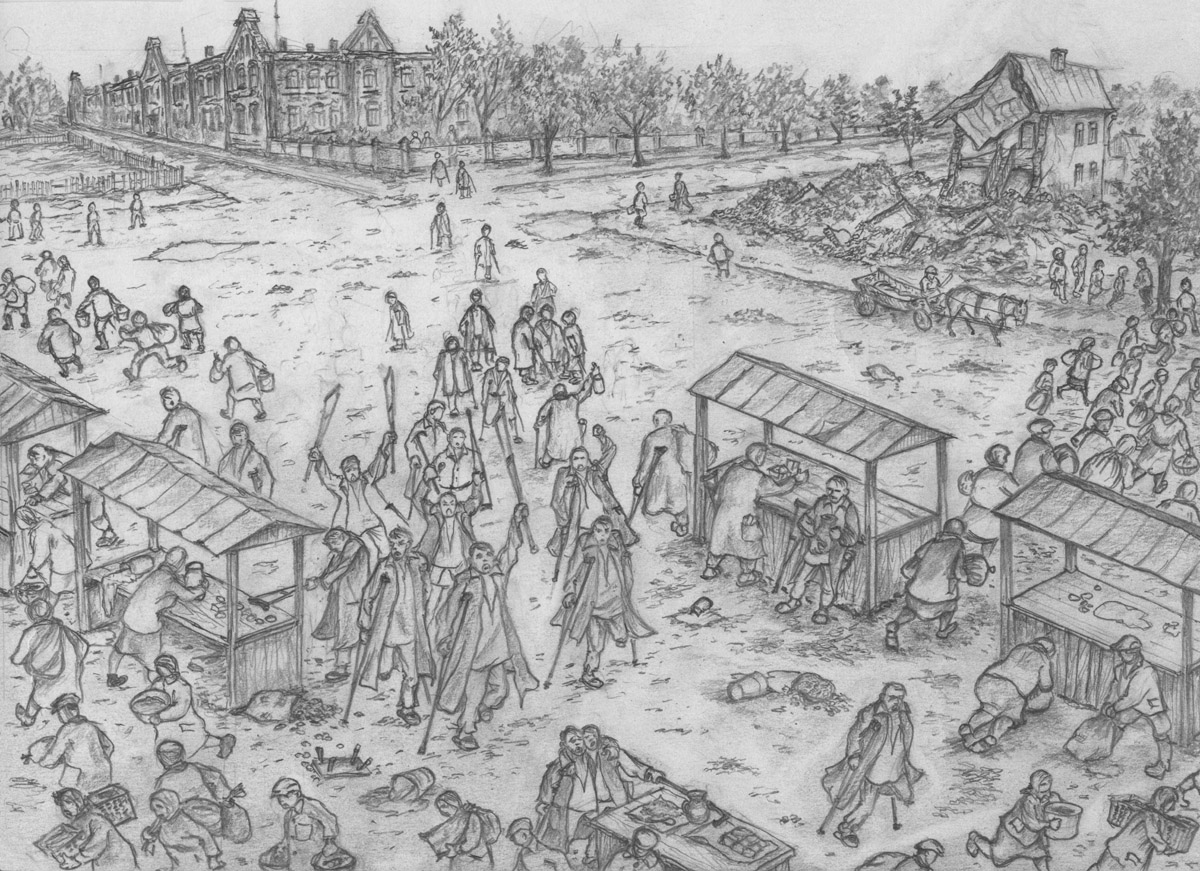
A certain threat to the bazaar world came, strange as it may seem, from the wounded soldiers at the military hospital located right next to the market. The hospital was housed in the former Russian gymnasium named after Traugutt. We visited the hospital wards several times with school concert performances. There were many seriously wounded men — many with amputated limbs. Convalescing soldiers crowded the pavements in front of the hospital on fine days, or sat on the brick fence. I witnessed, on one occasion, a large crowd of wounded men — brandishing crutches and walking sticks — fall upon the market stalls, scattering sellers and buyers, smashing everything left and right. People fled in panic. Whatever was left behind became the patients’ spoils — mostly food: butter, lard, eggs, milk, and the like. The military patrols and the police fled along with everyone else. No one dared enter into open conflict with the rampaging invalids. After the raid, the soldiers — loaded down with provisions — returned to the hospital. Some sat down beneath the fence to divide the spoils and rest in the shade of the chestnut trees, while the market gradually calmed and filled again with buyers and sellers. Before the hospital was relocated, there were several such raids.

A raid on the market by wounded soldiers undergoing treatment at the nearby military hospital. (Drawing by V. Gubenko)

In short, the bazaar was a noisy, fascinating, utterly remarkable and unfamiliar world of commerce, which I observed every day. But that was not the main thing. What struck me was the abundance of produce at the market. After the hungry years of evacuation, it seemed like a fantasy. In the newspapers I had read that the occupiers had plundered the population, that people were not merely suffering but dying of famine, that all provisions had been sent to Germany. I kept asking myself: where did all this abundance come from? The local boys were well-fed and well-dressed, and from our gaunt appearance and worn-out clothes they immediately identified us as Easterners. The peasants at the market who brought their produce were neither ragged nor thin. Their horses, with quality leather harnesses, looked healthy and strong; the carts were solid and reliable. And yet for three years they had been obliged to hand over a portion of their harvest to the occupiers as compulsory military quotas. Their bread and butter had also fed the partisans and the police — all the armed men of every stripe, who simply confiscated food, livestock, and horses from the peasants without payment. And often took their lives along with it. So what explained it? There are probably many factors. But the main one is that peasant farming was still individual. After the annexation of Western Belarus to the USSR, Soviet authorities had partially begun collectivization — but the process was interrupted by the war. In the first post-war years, Soviet power did not yet feel strong enough to forcibly drive peasants into collective farms. But by 1949, the hand of the state had grown firm enough that within two years, the mass forced collectivization of peasant households across Western Belarus was carried out. But that was still nearly five years away — which is why abundance reigned at the Brest market, while the post-war policy of forced grain requisitions applied to the already-existing collective and state farms condemned the rural population of eastern regions to mass famine in 1946–1947.” (From the memoirs of V. Gubenko)

The ruins after the July 1944 bombing raids. The Brest Central Market now stands on this site, running from Kuibyshev Street with its façade facing Pushkin Street. (Drawing by V. Gubenko)

Rebuilt many times over, the Brest bazaar eventually took on the form that newer generations of Brest residents have grown accustomed to. Some still call it the kolkhozka — though the word “kolkhoz” disappeared from the sign above the entrance long ago, just as the collective farmers themselves disappeared from behind the counters. It is now the domain of farmers, cooperatives, wholesalers, hired vendors — and, of course, seasonal mushroom and berry pickers. The bazaar has definitively become a market. Everything is orderly and regulated, prices clearly displayed. Coming across someone selling tomatoes they’ve grown themselves, or cucumbers — crisp and sweet, covered in tiny bumps, picked just that morning with the leaves still on and the little yellow flowers not yet wilted — has become a true rarity. Most of the stalls, with their identical assortment of vegetables and fruit, are staffed by city-looking women somewhere between 20 and 60, selling goods that are delivered centrally and distributed among the vendors. Buy and go. But islands of the real bazaar survive. Many people go exclusively to “their” vendors, with whom they’ve built years of trust and mutual benefit. Fresh cottage cheese from tidy Valentina; veal — reliably good — from dependable Gena; the sausage with saltison only from Raisa; Baba Vera says don’t take the apricots from her today — they’re sour, she’ll have sweet ones in two days. And then there are the chance encounters — inevitable at every visit, regardless of the day of the week or time of year — with acquaintances: you might exchange a few words, or you might get drawn in for an hour, or you might walk past pretending not to notice — but the fact of the encounter remains, one way or the other. So there’s no getting away from the bazaar. The bazaar is eternal and indispensable. You just have to know how to filter it.

A residential building across from the former bus terminal. Brest, 2018.

I’ve been waiting for so long

I am eager to talk about this man. Firstly, because he will turn 98 this year. Secondly, he uses an umbrella only when it rains, but not to lean on it while walking, and thirdly, he will give odds to many advanced Internet users and does not put on glasses, when he looks up at the phone. And he is also a bewitching interlocutor, a fascinating storyteller who has retained not only a bright mind, memory, but also a subtle sense of humor. Sure, an acquaintance with such a person can be appreciated as a gift of fate.

His name is Kurt Marx. He was born in August 1925 in Cologne. Kurt’s parents, Irma and Siegmund Marx, were assimilated Jews. In their understanding they belonged to the people of Germany, sincerely believing that they were an integral part of the German culture.

Kurt Marx on a walk with his father Siegmund. Cologne, Germany, 1926

After Hitler came to power, they, like many in Germany, did not believe that this madman would hold long in power. Even when their son Kurt was ordered to quit the gymnasium (secondary school), that he attended, and go to a Jewish school, because there was no place for a Jew among Aryan children, they still harbored the illusion that this nightmare would end soon. Yet it didn’t end. It continued with pogroms in 1938. The Jewish Yavne school, where Kurt studied, was set on fire. Classes were stopped. The question of salvation arose. The parents applied to leave for the United States. But the situation deteriorated quite soon so significantly that the parents urgently decided to save their only son first. Meantime, a secret company was organized in Germany to carry Jewish children to England, the so-called Kindertransport. England at that time was the only country that agreed to accept Jewish refugees. Erich Klibanski, the director of the Jewish school, that Kurt attended, gathered the first group of children aged 5 to 17 to be sent to England. He planned to save all his students, but only 130 managed to emigrate. Among them was Kurt Marx.

The document of identity, issued to Kurt Marx, to come to England as part of the Kindertransport rescue action. 1939

In January 1939, Irma and Siegmund Marx farewelled their son, whispering to each other at the station: “See you in America!”. At this moment the 13-year-old boy did not know yet that he saw his parents for the last time. What befell the children to go through, being cut off from home, from their families, from everything that makes a happy childhood, is another story. Nevertheless, they survived, avoiding the suffering of the Holocaust and that matters. Until July 1942, Kurt received rare letters from his parents, which they sent to England through the Red Cross. The letters were limited to 25 words, including the address. Kurt knew from his parents’ letters that they were going to be moved from Cologne somewhere to the east, where they would be provided with housing and work, and that they had already bought train tickets, paying 50 Marx for each. In the last letter, the parents greeted Kurt on his birthday in advance, wishing him happiness and health. Then the letters stopped.

The last letter from the parents dated July 19, 1942. Kurt received it through the Red Cross at the end of August 1942. “Our dear, before our departure, we send you our most cordial wishes. Be healthy. Think about us. To you, beloved son, our hearty greetings on your birthday. Be diligent and bring joy to those around you. Your dad and mom.”

For many years, Kurt tried to find any information about what happened to his parents. All the searches were in vain. And only in 1995, thanks to the evangelical pastor Dieter Korbach and the lists he published, one could know about the fate of 1164 Jewish children, women and men deported from Cologne. The pastor has been thoroughly researching the history of the Jewish community of Cologne for decades, to learn the truth about the doom and disappearance of the Jews from that city. At the age of 70, Kurt Marx learned that when he was reading the last letter from his parents, they were no longer alive. The director of the school, Erich Klibanski, who had rescued his students, was also not alive. His wife, his children, his students who were late to emigrate, all of them, like thousands of other German and Austrian Jews, were killed in Maly Trostenets, Belarus. Only in 2011, Kurt had a chance to come to the place of the death of his parents. In those days there was no memorial there, there were no tourists coming, there was no one. Just overwhelming silence, emptiness and a sense of relief. “I’ve been waiting for so long. At last, I have found you, I’m here, by your side. Do you hear my tears? Do you see my thoughts? Do you feel my prayer?”

Kurt Marx at the place of his parents’ death. Maly Trostenets, 2017.

Later, Kurt came to the place more than once. In 2017, he was invited to Minsk to the opening of the traveling exhibition “Maly Trostenets Death Camp. History and Memory”, which was created thanks to the fruitful cooperation of the Historical Workshop named after Leonid Levin and the International Educational Center in Dortmund. When I talked with Kurt, he easily switched from English to German, which remained for him the language of childhood, the language he spoke with his parents, the language that his late wife, Ingrid, who had survived Auschwitz, also spoke. But more than a dozen years had to pass before Kurt was able to overcome himself and speak the language of those who deprived him of his parents and brought so much grief. Kurt also expressed a very interesting thought. He said, hate is also a faith. It does not require justification or confirmation. I believe because I believe. And someone chooses hate as faith. Jews often became victims namely of the hate as faith. If you are a Jew, then a priori you are hated even by those who have never seen Jews. It is dreadful that such a blind hate extends not only to the Jews. Who is the next? Who will be allowed to be slaughtered by the demons of intolerance, aggression and evil? Think! Don’t let it be! The

Holocaust seriously wounded Kurt, but also gave him the strength to live and show us, living today, that there is nothing more valuable than human life, creation, love and peace.

Kurt Marx at the traveling exhibition “Making History Together”, dedicated to the history of the Belarusian Jewish community. London, January 2023

I was born in Brest-Litovsk…

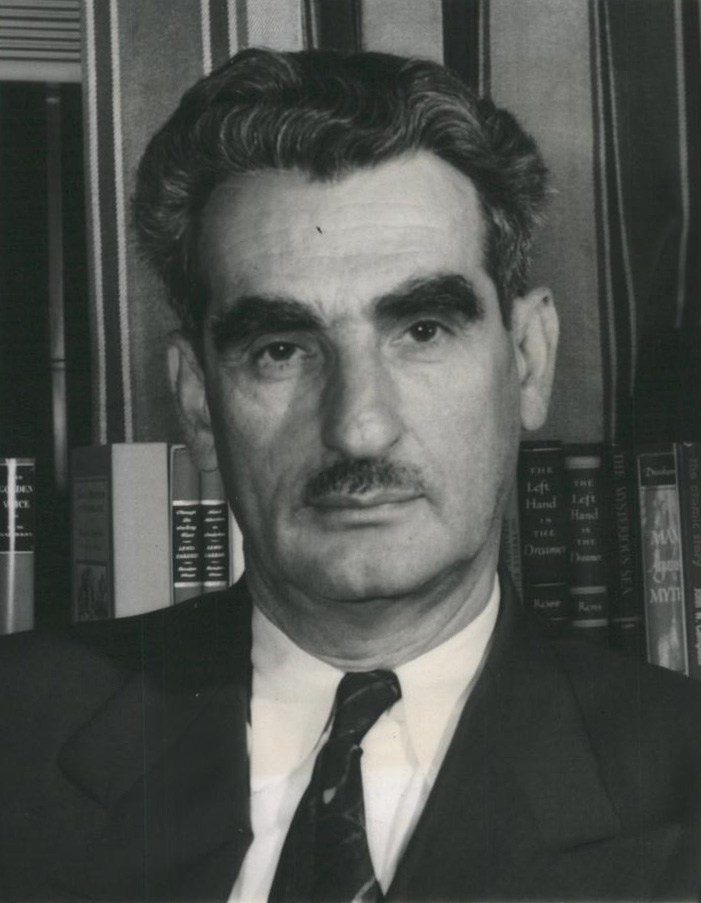
In the book “Symphony of the Jewish Tree of the Brest Region” by Vladimir Glazov (2019), among the wide life stories of the great and famous names of those who were born in Brest and its environs, there is just a small biographical essay about Joseph Aaron Margolies. Though, due to his professional activities, he was a rather public person, information about him is scarce and laconic. Just where he was born, worked, died. There is much more information about his son-in-law and grandson. The son-in-law, Leo Rifkin, is widely known in American theatre and cinema circles as the scriptwriter of the most popular TV series (The Addams Family, The New Adventures of Huckleberry Finn, etc.). His grandson became famous thanks to his work as an art director of the rock band Grateful Dead.

But one thing is clear, the son of a poor Jewish blacksmith from Brest-Litovsk, Joseph Aaron Margolies, managed to live a good and interesting life and he takes an honourable place among those, whom Brest can be proud of.

Joseph Aaron Margolis was born on December 25, 1889 in Brest-Litovsk. He was 12 years old when his family left for New York, America. Where and what he studied his biography does not mention, but we know for sure that at the age of 16 he began working as a library assistant at the Rand School of Social Sciences in New York.

“This library was founded by followers of the US Socialist Party, who considered comprehensive education of workers as one of their main objectives. Apparently, Joseph himself learned a lot during his six years work in the library. In 1912, he was employed in one of the largest bookstores in New York – Brentano’s, located on Manhattan’s famous Fifth Avenue. In the late 1920s, Joseph Margolies left the bookstore to become a commercial director of the Covici-Friede publishing house. However, the publishing house, on existing for about ten years, went bankrupt in 1938 and Margolies returned to the Brentano’s bookstore, which became almost his own. From 1944 to 1947, he was a director of the Council of this bookselling house, and in 1945-46, Margolies was the President of the American Booksellers Association. From 1955 until his retirement in 1960, Joseph Margolies was a manager of the Center for International Book Trade Affairs in the Foreign Policy Association and the Carnegie Endowment for International Peace” (Vladimir Glazov “Symphony of the Jewish Tree of the Brest Region”, p.84)

Joseph Aaron Margolies has definitely played a significant role in the development of the American book selling business. He died being a very old man, aged 92. He bequeathed his archive, comprising unique photographs, correspondence with prominent people of that time, documents, manuscripts, to the library of Columbia University.

Joseph Aaron Margolies took part in the Oral History Project. He was interviewed twice. The first interview in 1971 dealt with his professional activities. But 6 years later, in 1977, journalist Clifford Chanin asked Margolis to talk about his childhood in Brest-Litovsk. This interview was recorded on tape, that was presented to the William E. Wiener Oral Historical Library of the American Jewish Committee. Today this recording is held by the New York Public Library. The old man in it vividly and in detail describes, how Brest-Litovsk lived at the end of the 19th century. Unfortunately, that city no longer exists, as well as the people who lived in it, but they left us some memories, helping us get to know the history of our native Brest.

Brest-Litovsk. View of the residencial buildings on the New Boulevard. In the distance you can see the intersection with Shirokaya Street.


House

I was born in Brest-Litovsk. It was quite a big city. It must have looked much bigger than it really was to me as a child. But I remember perhaps forty-five thousand out of fifty thousand of the town’s inhabitants were Jews.

We lived in a fairly big building. There was no running water there. The water had to be taken from the well, which was outside a little distance, and brought home. No plumbing of course.

There was a grocery store at the other end of the building, Reb Meyer was his name. Everybody was called “Reb” there, “Rov,” Just as we say “Mr.” here. Most of the women charged, they didn’t have the money till payday. He had a late and he had a queer way of keeping records. He would write on the slate in a sort of a shorthand he had a tally, but my mother, who was a very good mathematician, kept it all in her head, she knew the amount.

There were all sorts of things in the street. I mean it was not very clean, especially the alleys were never clean. I came across that in Naples when I went into the Italian ghetto.

Neighbors came into our house. There were no telephones and no bells on the doors. Neighbor came in, that’s all. And if he came in during dinnertime he would hear, “essen,” which meant “Come eat with us”. But the slogan was “essen. Shainen dank.” So, this was the form, but they came at any time they wanted to come.

We had friends, we had a lot of relatives there too. My father’s sister lived close by, and I used to visit her quite a bit. She had a daughter, a very handsome girl, who was a cigarette maker, and she didn’t work in the factory, she would take the work home and she had a little machine where she would make cigarettes. And I would sit there and watch her, she was so quick doing it, and she would sing during the work.

Making cigarettes. Source: Photographing the Jewish Nation Pictures from S. An-sky’s Ethnographic Expeditions.

Apartment

I think the house had several apartments. We had a corner apartment on a street that was called the Breitegasse, Broadway but it was unpaved. It had a ditch, which I saw in Iran even ten, twelve years ago.

I can draw from memory a plan of the apartment. It was a kitchen, a big room, another big room, a dark room with a skylight from the other room, and that’s all. Three families lived there. Eight children had to live there and two parents in the apartment.

Our family lived in the big room. It was the corner room and it had windows to the street. We called the enormous room dining room, living room, bedroom, meaning all the same room. Over the table our family was large. We had a hanging lamp that we could pull up and down, which my father bought. Just as he had a front seat in the synagogue, he wanted this. Neighbors would come in to look at it. They lived in other rooms of the apartment. The next room was separated by an oven which heated the apartment. That was rented to a couple who had no children, and the wife ran a sort of a dressmaking business and my two sisters learned how to sew in that place. In other words, they didn’t have to go out to work, they worked there. This woman’s husband was one of the most remarkable people that I can remember in my childhood. He was a house-painter in summer, but he wrote the Torah in winter on parchment. He had these feather pens, and it was just marvelous. He took me in hand too, because he saw I was interested in what he did, and I would sit there and watch him write the Torah. He was a redheaded man, a charming guy, and he would look up at me as though I was his own child. They had no children.

Next in the dark room the only light they had was from the room where the sewing machines were, so there was a transom — lived a man and his wife and a young son who later went to the army, when he grew up. The man was a big, heavy, hulky man and the kind of a man that’s described in Sholom Aleichem as a am ha-aretz and he was a public carrier. He carried bundles for people, and his wife did the cooking and took care of her son when he was there. And the kitchen was a common kitchen for the three families, a big oven, and each one cooked his own meals. All the families cooked separately and ate separately.

Family in the house near the stove. Photographer Serzhputovsky A.K.

When I listen to the criticism of how the poor people live in Russia now, I’m incensed because there couldn’t be any more crowded living, specially of my family in such crowded conditions. Everyone in my family in one room and then two other families close by. I never felt the closeness really. There were three beds I remember. My brother and I slept in one bed, my two sisters slept in the other bed. Some of us slept on the floor, literally on the floor. In summer it was nice, because we slept outdoors, except on rainy days. In winter we slept four in a bed. Sometimes we had a guest, I don’t know where we put them, in the kitchen probably.

When a young baby is born, you don’t have these cradles that you rock on the floor, I never saw it in Russia at all. Maybe I did, I guess so. But in a crowded place where we lived the cradle is hung from the ceiling, hung by four ropes, so that when the baby begins to cry you begin to swing it, and I’ve seen that in many homes and saw It in my home. My younger brother, who was two years younger, which means that I was four years old, and I remember that well. Whenever the child began to cry my mother would say, “Kinder, Children, swing him,” or “rock him,” and he heard it so often that whenever he began to cry, he himself would say, “Kinder”. Everything was so close, because there were no separate bedrooms for children or anything like that, and this was part of the routine and I remember it so well, that cradle hanging from the ceiling.

The relations between the different families crowded so close together were fine. Excellent. My mother was very diplomatic, and she was very nice, and of course the couple, the man who wrote the Torah, they were superior people, both of them really were very fine people. This of course brings in my childhood. It was a good childhood.

Passover preparations. Source: Photographing the Jewish Nation Pictures from S. An-sky’s Ethnographic Expeditions.

Father

My father was a blacksmith. I would say more an ironworker. He was very deft; he could do anything. I used to bring his lunch to him when I was about six years old, and he worked alone with the anvil and the iron that he took out of the fire. It was hot and he would bend it, not with his hands, but he would bend it with pincers so easily that it was just remarkable to me watching him. I never saw him shoe horses and I don’t believe he did, because he was too good a man for that, he was inventive. He taught the people that employed him how to use tools in a certain way that would make things easier and cheaper.

I’m sure he didn’t earn much money. He worked for all Jews. If I remember right, it was about ten dollars a week. This is what I heard. He was religious in this way, that he had a seat in the synagogue, generally right with the big shots, and I remember sitting next to him all the time.

Blacksmith. Source: Photographing the Jewish Nation Pictures from S. An-sky’s Ethnographic Expeditions.

Mother

My mother was a very handsome woman. She was one of the wisest women I have ever known, though she was, I would say, Illiterate. She had a love for life, and people would come to her for advice all the time, not only relatives, but friends would come, and she had a very nice way to take people in.

She had to take care of a group of children, they were of various ages. She would send them to work, to cheder or wherever they had to go, make breakfast, dinner for them, she had to go out shopping, wash clothes.

When my father came home, he had to have a good dinner. although he wasn’t that kind who would knock on the table, but she had a good dinner. Yet after dinner of course the girls washed the dishes, they were old enough by that time to do it. She would sit down and knit socks for all the children. This was the hour instead of looking at television, instead of listening to radio, we would all sit there and talk to each other, and my mother had time for all that work, imagine that. So when she came to America, she said, “I don’t understand it, everybody curses all this stuff.”

She was that wise, she was a fine woman. If one of us kids misbehaved, she wouldn’t tell my father about it until he had his dinner. She explained that if I tell him before dinner, he might not enjoy his dinner, and sometimes he’d punish us, but gently. I don’t remember much about being deprived of anything. I remember when my mother told me the story that once I came home from cheder and I opened the cupboard, where the food was and she said, “There’s nothing there.”

Women and children. Photographer Serzhputovsky A.K. 

Children

My parents had nine children. There were two brothers and two sisters born before I was born and two brothers and two sisters after I was born. I came in the middle. My youngest brother was born in America, and he went through the usual American kind of thing, he went to a law school. After he graduated, he didn’t become a lawyer. Instead of that he went into theater and particularly in the movie industry.

All the boys, except my youngest brother who was born in America, had double names. My eldest brother was Hersch Yudel, my next brother was Itzik Leib, I came after, and mine was Yosef Aaron. The younger brother, who’s dead now, was Chaim Pinchas. But my youngest brother who was born in America, his name was Abraham. See, it was all practically biblical names.

My eldest brother was a carpenter. When he came to America, he became a teacher and he then became a dentist. The younger brother Itzik Leib was a tailor, a men’s tailor, and he made the most beautiful clothes for himself and for us, just marvelous clothes, and he was a very young man.

The girls, however, had only single names. The eldest was Esther, the next one was Eva, and then the next one was Rebecca, and then the last one who was born was Zlata. Zlata is not a Hebrew name, but it was probably a very common name.

My two sisters who came after me were seamstresses.

There was a great deal of self-help, everybody did the things, and my younger brother, he was really my buddy. You see, in a big family the children select their buddies. He was my buddy, I would take him by the hand and we’d take a walk into the qoyisher district to show him the gardens and the apple trees and so on. And we wandered around in this very quiet qoyisher neighborhood, we would hear a piano being played and so on, and we passed by a garden and there was a woman standing inside and she motioned to us to come over and she wanted to know — we understood a little Russian and she pointed to the trees — whether we’d come in and pick the apples, because we left for America in the fall. And we went there and I climbed on the tree and my kid brother was underneath with baskets, and we worked there for about an hour or more, they paid us a little money, I don’t know how much it was, probably a few kopeks. We filled a couple of baskets with the fruit and we brought them home.

The midwife and the children she helped to be born. Source: Photographing the Jewish Nation Pictures from S. An-sky’s Ethnographic Expeditions.

Toys

You would ask, what children, young children did in Russia in those days? We played with toys. You couldn’t buy toys. We had to make them ourselves. Having a father like ours, who could improve on it, then you’re lucky.

My brother Chaim Pinchas was two years younger than me. We both made our own kites. My brother and I in the summer would get up very early in the morning, maybe five or six o’clock, and we knew where there was a little factory that used a lot of cord. I don’t know what they used it for, and they’d throw out the small pieces. And we’d go around there and pick up everything we could and piece them together, tie the knots together until we got a tremendous run of it. Paper was hard to get there. And for a kite you have to have strong paper, but we didn’t have newspapers even. And we would make the kite and we would cut the ribs that the kites need, tie the tail and we’d make it fly.

We couldn’t buy skates, though there was a lot of skating around and in winter our street, which wasn’t paved, became a place where you skate. My father would put a wire somehow around the shoe and we were able to go skating on those skates.

Even Hanukkah dreydlech we would make ourselves, we would melt the lead and pour it into a form.

Игра мальчиков во дворе хедер. Источник: Photographing the Jewish Nation Pictures from S. An-sky’s Ethnographic Expeditions.

Schooling

Girls didn’t go to cheder. The boys had to, they had to know. So, we had a certain intellectual background.

I don’t remember the earliest time I was taken to cheder to learn, how old I was. They say at six years, but I must have been younger. I probably was five years old when my father wrapped me in his tallis, which was the custom. I remember the walk to cheder. I remember it as though it was today. You walked out of the house and you took a left turn and then turned left to the cheder.

I was looking forward to going to cheder. I was told you — you’re a man, it’s like Bar Mitzva. You become a man. And I guess perhaps they were preparing me from a very early age to look forward to going to cheder.

But I remember, I didn’t like the first cheder I had at all. I didn’t like the rabbi. He was dirty and I didn’t like him at all. He was nasty to the boys. He’d slap them on the hand with a cane and so on and so forth. As a matter fact, as a child of six, he made us read the Gemara.

Хедер. Источник: Photographing the Jewish Nation Pictures from S. An-sky’s Ethnographic Expeditions.

But later on, I went to Talmud Torah, which was a Jewish public school, a real school. That was taught in Yiddish. They taught us reading and writing all in Yiddish. It was run beautifully, very fine. We had to register every season, every semester, whatever it was called, and you’d get a ticket, and they’d assign you a class. The classes were very nice. We sat in a sort of an open square and the rabbi was in the middle there. The teaching was much different, they had very good teachers there. It was a real school. We learnt both religious and secular subjects. Jewish history, not religion and the three R’s, reading, writing and arithmetic like in the primary schools in America, the first things any person needs as introduction to culture. They also had sessions teaching Russian. That was part of that Talmud Torah. The Russian was evidently paid by the Talmud Torah, because I don’t believe that the government would pay for any Jewish school at all, I doubt it very much I remember the Russian teacher very well. He was not a Jew. He was a nice man with a small red beard. He was a lovely teacher; he knew how to teach children. He’d come about twice a week. Whatever few Russian words that I know even now, I learned from him.

In the school they also served you lunch. It was run by the Jewish community.

Талмуд-Тора, Ковель. Источник: Photographing the Jewish Nation Pictures from S. An-sky’s Ethnographic Expeditions.

Reading

I read it even before cheder, because our home was a sort of a semi intellectual house for what we had. I remember once a young girl came to the house, I didn’t know her, she wasn’t a relative, she was a stranger. From my recollection now, she may have been fourteen or fifteen years old, and she said, “I understand that you can write.” I said, “Yes, I can.” She says, “Would you write a letter for me?” I said, “Yes, sure.” She told me what to write. I probably was by that time eight years old. I didn’t realize what it was until years later. It was a love letter she wrote to a boy.

There was common reading material for the Jews. We didn’t see a newspaper in Brest-Litovsk. I don’t remember seeing a newspaper at all. Maybe my brothers did. They always read, but I didn’t see a newspaper.

My father also would do some reading out loud. My father always read to my mother, while we kids would play. We had things to do, we would play on the floors. My father would read to my mother some stories. I still remember, “Dos Tepl” and various stories like that. I was always eager to see them printed. I used to read them, but of course they were a little above my age. I read Sholom Aleichem, Mendele Mokher Seforim and many others. I suppose, Peretz was already there. I mean those were the great lights, the big ones, and later on of course there were others.

Бейт Мидраш. Источник: Photographing the Jewish Nation Pictures from S. An-sky’s Ethnographic Expeditions.

Language

The language, that I was raised in was Yiddish, absolutely Yiddish. That was an earthy language. Yiddish is a wonderful language. If you read Sholom Aleichem, you’ve got to read him in Yiddish, not in English. When I came to America I didn’t know any English at all. I knew a little Russian, and of course I found German quite easy, although I speak it a little. I used to go to the German theater, and I’d get every word because of its relation to Yiddish.

But my mother had a gut vortl, a good word for every incident. She would speak in Polish, in Russian and in peasant language. She said, “Der goy sacht,” and then she’d speak in that language always to the point. She would never tell a story, unless it was an appropriate story. I learned that from her. I learned that you must never tell a story, unless it’s appropriate, especially if it’s a little off-color joke.

It was common for adult Jews not to speak a word of Russian. Well, they just didn’t learn it. They could have done it. No one kept them from it, but just they didn’t want it. They were absorbed in other things. I don’t think they considered it not kosher or anything like that. Just a matter of not having the time for it.

Religion

My parents, while they were good Jews, they weren’t too religious. There was a liberalism in the home. My father read a great deal when he was able to rest from his hard work.

I remember the synagogue very well. It was like a big temple really with a high ceiling and I always wondered how they get up to the lights up there, never realizing they pulled them down.

On the big holidays the place was filled. Father would bring me and my brothers to the synagogue, but not sisters. The women didn’t go except on the big holidays. Of course, they went upstairs or in the back, wherever it was. But I always went with him went on Shabbos Friday night and Saturday morning.

Sometimes I was bored, but in the main it was all right, and the reading of the Torah and everything else, it was very exciting. The ritual is very, very attractive.

Редкий кадр интерьера Большой синагоги. Источник: 

When it got noisy the shammes would clap his hand on the big book, till it was quiet, and it reminded me of home really years later, that’s universal.

On Saturday afternoon after the dinner and after the nap, we’d go to the synagogue and there was always what they called a redner, speaker, and generally they were very glib speakers, spoke very well, and they told anecdotes about what happens to Jews here and there and they’d quote the Bible and they’d quote the prophets and so on, and they’d make a collection, that was his occupation. And I don’t want to mix that up, but it’s very possible that Jesus Christ was that kind of a man, because he always lectured, always talked to people and so on.

Oyrech auf Shabbes means a stranger for the Sabbath. Bringing a stranger home to your Friday night meal was common. I have an idea that there were many shnorrers who took advantage of it, but you couldn’t help that. But in the main they were people who were very quiet. Some men talked a lot. I suppose they were just businessmen, travelers. There are a lot of stories about those people.

There were many Hasidim in Brest-Litovsk.

Not far from where we lived, they had what they called a Hasidic shtibl. It wasn’t called a synagogue. It was a house, a Hasidic house. And as kids we would stand in the doorway of those places and watch their curious antics, and we all looked down on them, all the Mitnaggedim looked down on the Hasidim.

There was no interaction between the two kinds of Jews. I suppose just the fact that one thought that they were superior to the others, but I never saw any. We didn’t have friends among the Hasidim at all.

My parents talked about Hasidim that they are too obsessed by their religion. Also, a curious fact was that Hasidim were too happy. They were merry. They sang and they danced and so on. The average Jew didn’t dance.

Разносчик мацы. Источник: Photographing the Jewish Nation Pictures from S. An-sky’s Ethnographic Expeditions.

Diet

It was a kosher home, absolutely a kosher home. We bought kosher meat absolutely. My mother would go to the rabbi if she found a blutzdroppen in the egg or in the chicken. If it wasn’t kosher, she would have thrown it out. We never ate meat during the week, only on the Sabbath.

Our diet was excellent, although only on the Sabbath we had chicken or any kind of meat. I attribute my long life to the diet that I had, when I was young.

The diet during the week was a plentiful diet, although you didn’t get any meat during the week. You might get rather what they call the chitterlings. The chitterlings are what the blacks call soul food, which consists of liver. Liver was very cheap and, as a matter of fact, when you bought meat, they’d give you the liver for nothing. And then there was gefilte kishka. You know, my mother would stuff this, the derma, put wonderful things into it.

We always had marvelous soup, thick soup, be it with a nice marrow bone. We used to have soup every day. As a matter of fact, one of the meals was cold soup. It was very fine, a mixture of barley, beans, peas and carrots.

The food was generally better then. Practically all fresh food, except in winter we didn’t have the fresh food, but we had the carrots that were always good. My mother would buy in summer cucumbers counted what was called in Russia shuck, sixty cucumbers in a shuck. It was the measurement that the peasants would come with their wagons, and they would sell cucumbers to whoever wanted to buy them. My mother would pickle them herself. I can assure you it was really a delight to eat. When we left for America, my mother took along a small barrel of these cucumbers, although we could have bought them on the ship later, when we ran out, because we went on a German ship and they had plenty.

My mother was one of the most wonderful bakers. She would make a challa about two and a half feet long. It was a big family. She’d make always two, always two, because Friday night when Father came home from the synagogue he would sit at the head of the table, and I remember often my mother forgot to put a knife down there for him to cut it and he couldn‘t speak. After he made the broche, he could. Then in Yiddish he’d speak, “Messer”.

Preparing for the Sabbath was really an event. The house was cleaned up beautifully, a white tablecloth on the table, my mother would bentsh licht, and it was an event, the ritual was very fine. And then we would all sit around the big table — we had a big table — and my father would make a broche by the bread there and he would cut slices for each member of the family and then we’d all eat. We had chicken and all sorts of tsimmes. My mother was a very good cook, and it was very pleasant.

The Passover was a terrific, big holiday, and you really had to scour the place, really clean up the house, burn all the chometz with prayers.

You couldn’t buy matzoth in boxes or packages, you had to make it, so what they did was to organize a little cooperative play of fifteen families and they hired a real bakery. The baker would clean the place up, so that there was no breadcrumbs in the oven, you see, and it was arranged in this way. Suppose there were ten cooperators. Each one would be assigned a day when their matzoth would be baked, and everybody in the cooperative, all the women in the cooperative would work for this member, roll the matzoth and so on, and there was one boy who would sit on a table — that was myself — to put a measure of flour into a bowl, big bowl, and my brother, who was two years younger, he must have been four by that time, he would put in water. That was assigned, exactly a measure of this, then a measure of that. You don’t put salt into it, I mean just water, a little water and flour, that’s all.

Then there were two women who would knead the dough. There were tables, long tables that were covered with a clean metal, so that the matzoth didn’t touch the wood because the baker used to use it for his bread.

And when the dough was brought onto these tables the cooperators, the women, would stand there with rolling pins and roll them, and the matzoth were always round, because you can’t roll square matzoth. Then the man would come around with something that scraped the top of it so it wouldn’t rise, making little holes in them with a little role that had points on the bottom. So it will not rise when it was baked. And then it was taken to the oven on a long shovel, so to speak, full of butter, and he put it in the oven, and when it was through the woman would provide a basket and it was done for the day. This was done for every member of that little cooperative.

Выпечка мацы. Источник: Photographing the Jewish Nation Pictures from S. An-sky’s Ethnographic Expeditions.

On a smaller scale there was another cooperative and that was preparing the hot food for the Sabbath. You’re not allowed to cook or light a match or anything on the Sabbath. So, our apartment was fixed with a very big oven, very deep and so on, and my mother made it a sort of a headquarters of the women in the little commune that we were in. There must have been about ten of them. They brought their food on Friday afternoon. It was all closed up in earthenware pots generally, they had their dinner for the next day. And my mother would heat up the oven with wood and than clean it out with a brush or something, and that was put in Friday afternoon and then the oven was sealed and it stayed overnight that way until the next morning, next day, and just before the men came back from synagogue they would come and get that. My mother would take the pots out and put them on the floor and each woman would identify their own pot. They also left a little coin for the wood that was used. There was no charge, but this was a custom. My mother didn’t accept any pay, like the baker, who was a professional. Well, the opening of that pot, it really was the most pleasant smell. They put the finest things into it, and it was real hot. I can never forget it.

Political Atmosphere

I remember not very much the political atmosphere at the time I was growing up, but there was talk about it.

My eldest brother Hersch Yudel, who I remember extremely well, was an ardent Zionist from the time he was able to say the words Zion and Zionist. In America in his room he always had a picture of Theodor Herzl, this very handsome man standing in front of a rail of something. My brother belonged to a group of young boys and girls who were Zionists. In fact, later on when we were in America, he and I never got along because I was a Socialist and he was a Zionist. Being older than me, he sort of kidded me all the time about it.

My second brother, Louie we called him Itzik Leib, belonged to the Bund. He was a revolutionist, he was about, I think, sixteen or seventeen when he joined the Bund, the Yunge Bund, which was the Social Democratic Party, the Jewish branch of it. And my mother told him that she’s getting worried about him because he was getting to be outspoken. He was a sort of a firebrand anyway. So, he stood up on the table and yelled out loud, “Tsar! Down with the Tsar!” Well, my mother just nearly died. Fortunately, no one heard this, it was indoors, and this is the kind of a guy he was. We did hear of arrests and so on.

Фрагмент карты Брест-Литовска с жилыми кварталами и интендантским городком.

Army

There was an armory next to our house. The soldiers made a tremendous impression on me and also on the other young boys of my age that I associated with. They were so close to us and their big yard wasn’t big enough to drill, so they’d go out into the street. They didn’t have music, but they had a drum of course in order to keep the rhythm, and they would march up and down the street, drill there and the kids, four or five of us, would always follow them and the soldiers liked that. We would follow them, drilling the same way they did.

And when ration day came around, they were given their rations. It would come in a truck. They would get their rations for the week, I think. Bread, for instance. They got a big round loaf of bread. And when they got the rations, they would come out and sell part of it to the natives seven kopeks a loaf. It was the most delicious bread, all black bread. It was black, but it was wonderful. I still remember the taste of it.

And what they did with the money was to go out on the town, buy themselves a little vodka and buy these sunflower seeds and they would eat the inside and they’d spit out the shell. The streets generally were filled with those seeds, with those shells. This was a habit of theirs. Not only of theirs, but most of the Russians would do that.

And also they had parties in the barracks and they would invite people to come in. And there they had music, they had these accordions. They were marvelous accordion-players, all of them.

In the Russian Army — I imagine it works the same way like in most armies, no native boys stay in the city where they were born. They send them far away and they bring faraway people to our city, so we never knew them, and I think it’s done deliberately, they’re always afraid of riots or revolutions or so on, that sort of thing.

My eldest brother, who was called for service must have been eighteen or nineteen years old, and of course he didn’t want to go. So, he did what most of the Jewish boys did there, they underfed themselves and did not sleep for a month before they were called to report. And he and a friend of his were called together and they wouldn’t allow each other to sleep more than two hours, one was awake and the other was asleep. If he slept more than two hours, he’d wake him up. And they didn’t eat much, they actually starved themselves. So, my brother and this other fellow were completely underweight and groggy, so they were not taken. It was widespread among the Jews.

The man who lived in the dark room of our apartment, he was drafted. Though they sent him away, far, far away, he came home on leave, and he looked marvelous, he looked better than he ever looked. He was well fed, he said. And when he was through with the army, he came home. Once he was sitting on the stoop of a house near the armory, and an officer came by, he was already in civilian clothes, this young man. And when the officer came by — I was there when it happened — he stood up and saluted, because he still thought he was in the army. His family moved soon after he came from the army and I never saw him again.

Washing in the Bug River

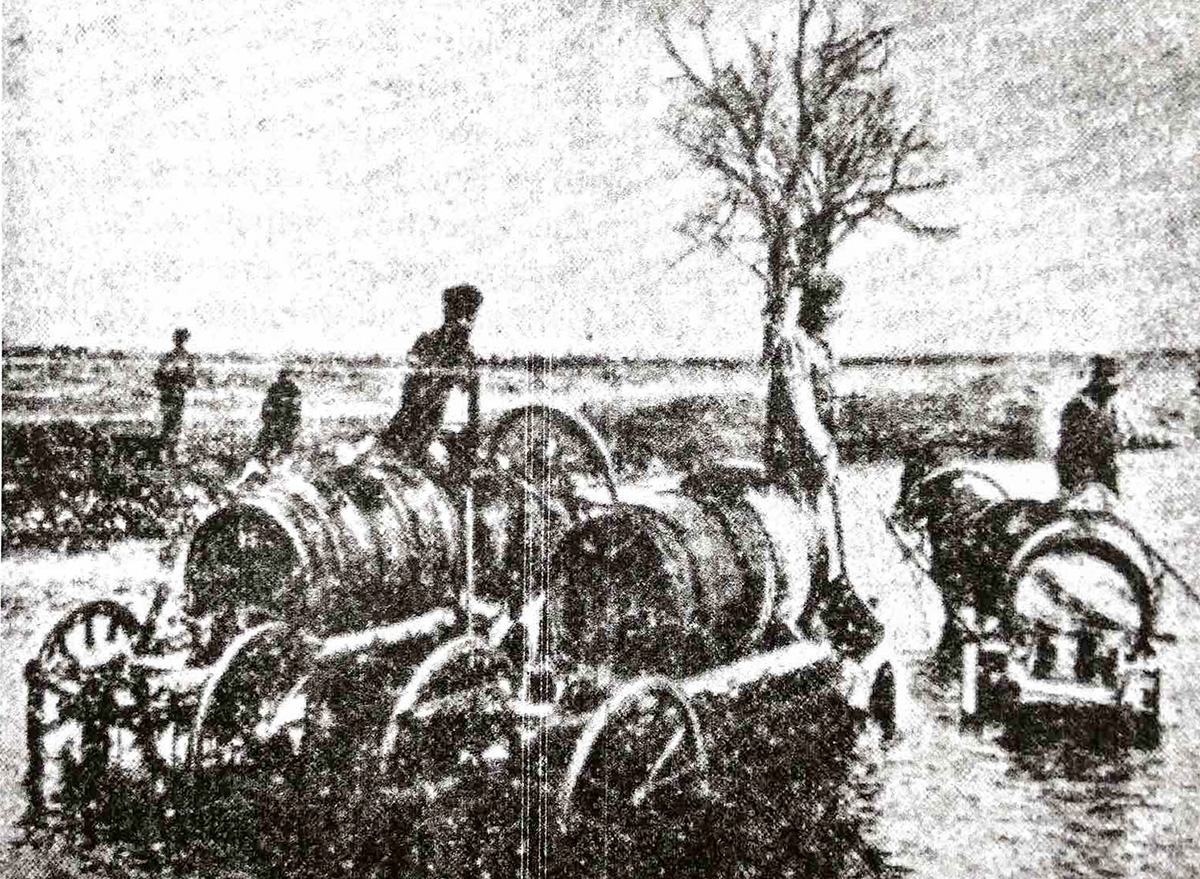
You wonder what was done about getting clothes clean, when there was no water in the house. Well, Brest-Litovsk had one of the finest rivers, the Bug River, which was quite a wide river. And once a week, or maybe once every two weeks, my mother joined many of the other women and went to the river to wash their clothes. They would put the clothes into river water. When they were wet, the women would pound them on a rock or on something flat. And the only other place I ever saw this done, on a much bigger scale than on the Bug River, was in India. In Bombay I saw hundreds of men and woman do this, the same thing to their laundry on rocks that my mother used to do and many other women did in Russia and it reminded me of home.

When the women came home, those clothes were clean and had to be ironed. Of course, the ironing was done at home. It was more work. The women all worked all the time.

Водовозы набирают воду в реке Мухавец в Брест-Литовске.

Travel to America

My father came to America first and this is an interesting story. My father had a co-worker in Brest-Litovsk, Zbunchik was his name. He was about the same age as my father. He was kind of a homely man, but he was a marvelous guy, good-natured and wonderful. Being a bachelor, he saved up some money and he was the one that put the idea of going to America to my father

People went to visit America and came back showing how well-dressed they are, painting such a glorious story of America. We also had letters from our friends in America. The impression they created was one of prosperity. In fact, the slogan was that money grows on the sidewalks. Streets are paved with gold. They said money, you’ll find money. Well, you could find money, but how much money could you find? Well, Zbunchik staked my father and they left Russia together. Of course they had no reason to be held back because they weren’t of military age anymore, but still to leave Russia was a trick. You had to get across the border by paying somebody something.

My father stayed in America a year and saved up a little money, probably lived in very bad quarters, I don’t know where they were.

We got very lovely letters from him, encouraging, saying that he was able to find work. My mother didn’t rely on crossing from one country to another on luck the way most of the immigrants had to go through, in Germany or in Poland or so on. She went right to the authorities in Grodno. Grodno was the capital of this particular gubernia where Brest-Litovsk was a city. And she took my sister along and she left the other children with neighbors and she went to Grodno, to the capital. She came back with a passport for all of us, one passport. She reduced the age of all the children, although she didn’t have to, but she wasn’t sure, if she may have to pay full fare for me and so on. My greatest loss in life is that I don’t know what happened to that passport, it was really a gem.

Before we left for America, my mother sent us to the barber to get a haircut because we were leaving in about two weeks or a week, to look good when we come to America. We went to the barber and he really clipped us. I mean, payess were taken off and everything.

We crossed the grenetzwhich is the border on a railroad train, which was just perfect. The train stopped at a town in Prussia. We were isolated for a couple of days there and then we had to go through fumigation process where they fumigated all our clothes and they examined us naked and we all passed anyway. On the day we had to leave, we had to pick up our clothes on the other side of a fence. They were quite warm yet. From there we took a train to Berlin. We stayed overnight in Berlin and the next morning we took a train to Hamburg and from there we took the ship to America.

Иммигранты на Атлантическом лайнере «S. S. Patricia»